Inquiry
Form loading...
Choosing a reliable Frozen Squid supplier in 2026 takes more than comparing prices or reviewing attractive product photos. The market is broad and data must be read carefully. FAO’s The State of World Fisheries and Aquaculture 2024 reports 223.2 million tonnes of global fisheries and aquaculture production in 2022, including 185.4 million tonnes of aquatic animals. These figures cover many species, not squid alone, but they show the scale of the supply chain buyers must assess. For squid-specific trade patterns, UN Comtrade data can help identify exporting markets; it cannot verify an individual supplier’s product quality or handling practices.
Look for evidence tied to the actual lot: species name, catch area, harvest date, processing site, freezing method, glazing percentage, and net weight. Ask for recent third-party audit documents and product test results, then check that the lot numbers match across records. A temperature log should show how the squid moved from processing to shipment, not just provide a single reassuring reading. Small details matter. A carton label that says “squid” without a species name leaves room for avoidable confusion.
One uncomfortable truth: a polished certificate does not prove every shipment was handled well. Request a sample, inspect thawed texture and odor, and compare the delivered product with the agreed specification. No checklist removes all uncertainty. But clear records, responsive answers, and consistent sample quality give buyers a firmer basis for choosing a supplier in 2026.
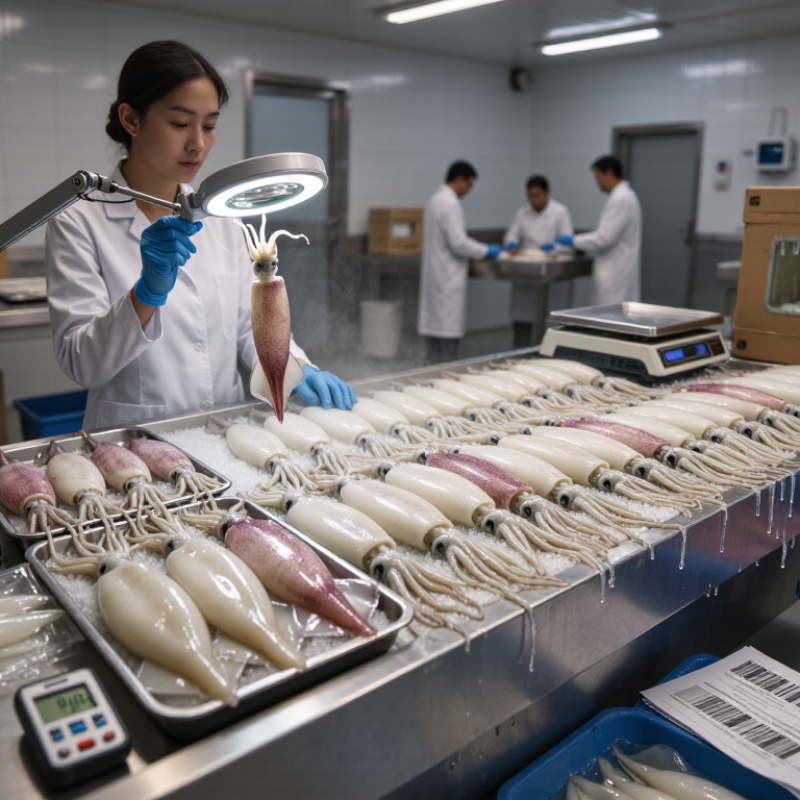
A reliable frozen squid supplier should identify the species by its scientific name, not just “squid” or “calamari.” Different species can vary in size, texture, flavor, and yield after thawing. Ask for the scientific name on the specification sheet and check that it matches the product label and invoice. Names can mislead. Common names may cover more than one species, so confirm any ambiguity before approving a sample.
Request the catch area, fishing method, and harvest period for each lot. An FAO area is a useful starting point, but it may be too broad to explain where a shipment came from. Ask for supporting records that connect the catch to a landing site, processing date, and finished-product lot. For example, the lot code on a carton should lead back to records showing when the squid was processed and frozen. Details should agree across documents.
Traceability is only as strong as its weakest handoff. Compare lot codes on cartons, packing lists, and temperature records, and ask how mismatches are resolved. A supplier should explain its system clearly and provide documents promptly. Paper trails matter. Still, paperwork alone cannot prove every detail; periodic checks and product trials offer useful confirmation. If a supplier gives vague answers about species or origin, pause before placing a large order.
Illustrative audit examples: The sample lot references and document details below are fictional. Use them as a checklist, and verify every claim against the actual lot records and applicable import requirements.
| Lot Reference | Declared Species | Catch Area | Catch Method | Lot-Level Traceability Checks | Product and Cold-Chain Checks | Buyer’s Verification Action |
|---|---|---|---|---|---|---|
| Example lot A Harvest year: 2025 |
Argentine shortfin squid Illex argentinus |
Southwest Atlantic Ocean FAO Area 41 |
Confirm the method from the vessel log and catch records; do not infer it from the species name. | Match the lot code across the packing list, processing record, catch documentation, and health certificate. Check vessel identification and catch dates. | Confirm product form, net weight, glazing declaration, packing date, and documented frozen-storage temperature of −18°C or colder. | Request the source records and reconcile lot quantities and dates before approval. |
| Example lot B Harvest year: 2025 |
Humboldt squid Dosidicus gigas |
Eastern Central Pacific, FAO Area 77, or Southeast Pacific, FAO Area 87; the exact area must be stated for the lot. | Check the declared gear against vessel and catch documentation. Confirm that the records identify the relevant fishing trip. | Trace the processing batch back to the vessel, trip, catch dates, and stated FAO area. Confirm that the same lot identity appears on cartons and export documents. | Review freezing and storage records, packaging integrity, and any temperature excursions documented during handling and transport. | Do not accept a broad ocean-area description in place of a specific, documented catch area. |
| Example lot C Harvest year: 2025 |
Japanese flying squid Todarodes pacificus |
Northwest Pacific Ocean FAO Area 61 |
Compare the stated fishing gear and vessel details with the catch declaration and trip records. | Request a lot-to-vessel link, catch-period details, processing date, and records showing how the raw material was assigned to the finished lot. | Check species labeling, declared processing form, net and gross weights, storage conditions, and the lot code on outer packaging. | Resolve any mismatch in scientific name, area, dates, or lot code before purchase. |
| Example lot D Harvest year: 2025 |
European squid Loligo vulgaris |
Northeast Atlantic, FAO Area 27, if this is the documented harvest area. | Verify the actual gear and fishing location from the supporting records; the declared species alone does not establish either. | Check the catch certificate or equivalent documentation where applicable, vessel details, landing or transshipment records, and processing-batch linkage. | Confirm frozen condition, storage records, date coding, packaging details, and that declared weights are consistent across documents. | Confirm that the species and catch area meet the rules of the destination market. |
| Any proposed lot | Scientific name must accompany or clearly correspond to the commercial name. | Request the specific FAO area and, where available, the more precise catch location required by the buyer or destination market. | Ask for the documented gear type and check it against the applicable fishery and import requirements. | Require a consistent lot identifier linking catch, landing, processing, packing, and shipment records. Check document dates, quantities, and vessel identifiers for gaps or conflicts. | Set written specifications for product form, size range, glazing, net weight, packaging, storage temperature, and acceptance criteria. | Approve only after the records are consistent, the lot is identifiable, and required certificates are valid for the destination market. |